
How we make friends

9 years ago, I met my best friend at a friend’s house party. Actually, it was a friend’s friend’s boyfriend’s house party? It was a long connection and I am not sure now why I happened to be there.
But I was, and so was he. That’s how we met.
We were both new to the city. We had little money, even fewer friends and plenty of time. So we began to meet every now and then and hang out here and there.
I say ‘here and there’ because I don’t remember going to any specific places to eat or attend events. I also don’t think we could afford to. We both lived near central Bangalore, the only place in the city where footpaths not only exist, but can also be used for walking. So we would just meet at a common spot and then walk from one place to another, here and there.
I was 2 weeks into my first job. He was taking a course to pivot into a different field. We were both starting from scratch.
Although, now we both have thriving, successful careers, back then, we didn’t know where life was headed. The city and its people were indifferent towards us. We were just “nobodies” - which I realise in hindsight is a great place to be in when you’re looking to make friends.
When a nobody meets a nobody
When we are in school or college, we are a "nobody" to the world. We don't have a social status of our own and an identity beyond our grades. When we move into cities, take up jobs, and grow into our careers, we become a "somebody". We are "somebody" with a job, a CTC, a vehicle, a postal address.
When a "nobody" meets a "nobody", there is a lot of room for friendship. We are collectively vulnerable in our "nobody-ness".
As a result, schools and colleges become fertile grounds for friendship. This is even more heightened in boarding schools and army camps. Collective vulnerability paired with strong formative experiences leads to deep connection.
In contrast, when a "somebody" meets a "somebody", it more often than not turns into a networking event, not friendship. In such groups, we start asserting our carefully built identities. There is performance and projection. And so, drinks, game nights, and general hanging-out-activities in the city do give us acquaintances but rarely friends.
Then dejected, we reminisce about the comforts of our childhood friendships and wonder why nothing matches up to what it felt like once. We blame our busy schedules. But it is not time that we’re short on, it is a lack of formative experience often rooted in collective vulnerability that is unable to bind us together.
As a side note, I do think time is important in the sense that the more time we spend together, the more we are able to experience formative experiences together. That is why romantic relationships become deeper connections in adulthood faster than friendships do. That is why stronger bonds are formed in the office balcony than at the company off-site.
I met someone recently who asked me, “When was the last time someone entered your inner circle of friends?”
I thought about it and said, “8-9 years ago, I think.” She told me it was the same for her.
We’re both the same age, living in a bustling city, with exciting jobs that introduce us to interesting people all the time. We have many, many acquaintances, but very few of them have crossed into the sphere of deep friendship.
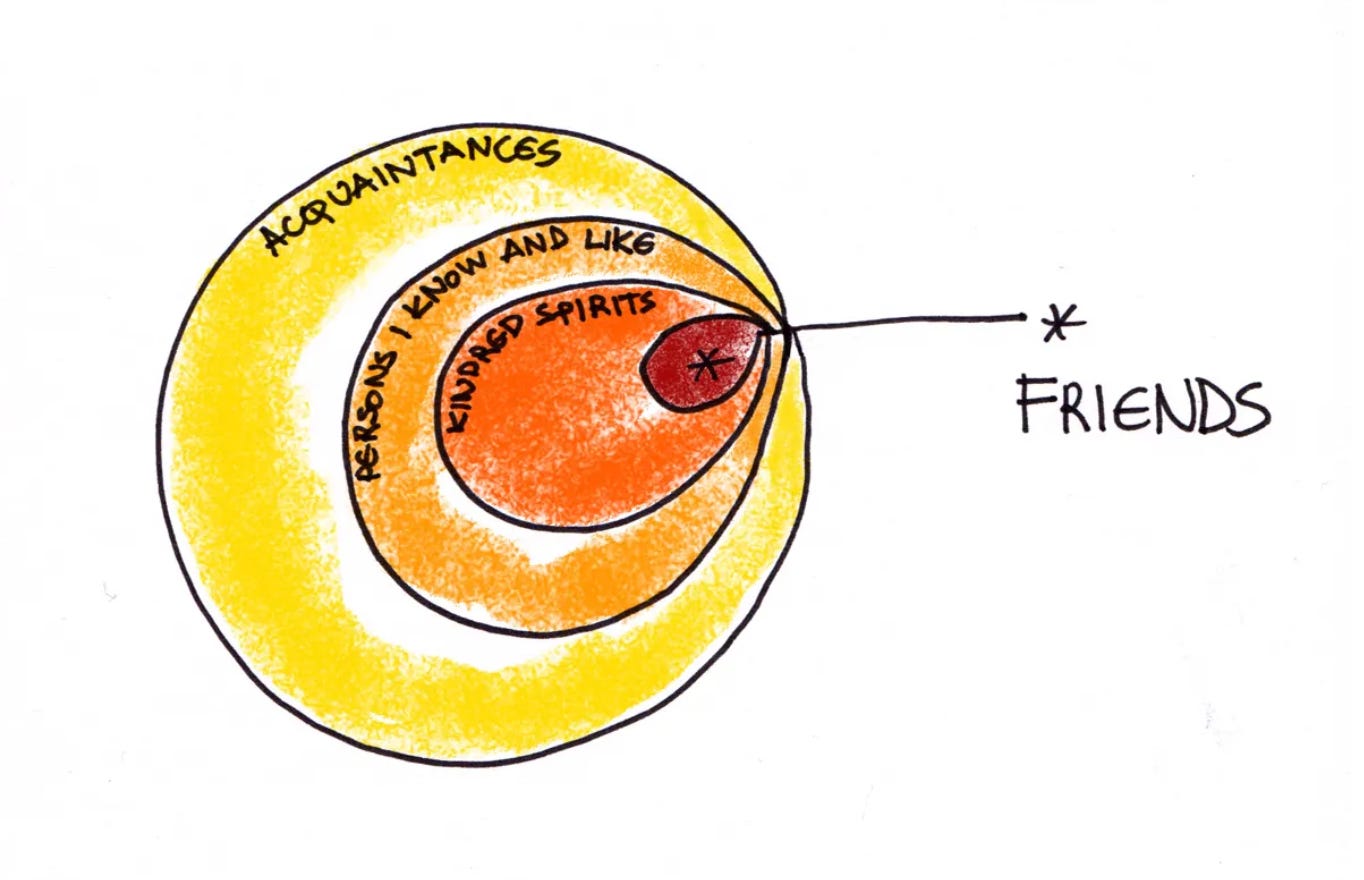
The above image is from one of my favourite blog posts on friendship by Maria Popova. In that she talks about what it really means to be “friends” and how often we use that word loosely to call anyone we know as a friend.
“A friend is a person before whom we can strip our ideal self in order to reveal the real self, vulnerable and imperfect, and yet trust that it wouldn’t diminish the friend’s admiration and sincere affection for the whole self, comprising both the ideal and the real.”
The greatest friendships in history were between somebodies
When we grow up and turn into “somebodies”, we are more well-formed as people. This process sometimes alienates us from our childhood friends, what we call as “growing apart” but the same process is also what leads to some of our lives' most meaningful relationships.
Some of the greatest friendships in history formed over artistic or scientific collaborations between people. Einstein and Max Born, CS Lewis and JRR Tolkien, Tagore and C.F. Andrews. In these relationships, the bedrock was not a formative experience but a field of common interest and mutual admiration that brought them closer. The formative experience formed later.
Lewis wrote to Tolkien in one of their exchanges, “Tollers, there is too little of what we really like in stories. I am afraid we shall have to try and write some ourselves.”
Their bond lasted for decades in which they both wrote to each other and encouraged and critiqued each other’s writings.
When CS Lewis passed away, Tolkien wrote of his friend, “The unpayable debt I owe to C.S. Lewis was not influence but sheer encouragement. He was for long my only audience.”
While they didn’t technically collaborate on a work of art, they shared a common love for a third thing, and had mutual admiration and respect for each other’s work.
Here, it is important to note that their “work” was who they were. It wasn’t their “job” that brought them closer, it was their “work”. When we do the work that we’re most curious and excited about, the kind where we pour ourselves into it, we are likely to find others who can speak to us in ways that touch our souls.
Max Born and Einstein had a bond that lasted for over 40 years in which they discussed physics, world events, family life and more. One of the most beautiful facets of their relationship was the mutual respect and admiration they held for each other. In one of the letters, Born writes,
“Dear Einstein,
[..] As regards physics, first of all, your kind remarks about my activities spring from the kindness of your heart. I am fully aware, however, that what I am doing is very ordinary stuff compared with your ideas and Bohr's. My thinking box is very shaky - there is not much in it, and what there is rattles to and fro, has no definite form, and gets more and more compli-cated. Your brain, heaven knows, looks much neater; its products are clear, simple, and to the point.”
Similarly, Einstein once advised Born, “Theoretical physics will flourish wherever you are; there is no other Born to be found in Germany today”.
This doesn’t necessarily mean that writers and writers must be friends, or scientists and scientists will be friends. That would be a crude distillation of a broader idea of what brings us closer - which is how much we are able to make each other feel seen in ways others can’t.
As adults, we feel seen through our work. We feel seen through our interests. This also means that as we grow older, it is important to become who we are, to pursue things that speak to us the most, and most importantly, put ourselves out there.
This not only helps us come into our own selves but also allows us to find others like us, with whom we can discuss, talk, collaborate on third things, and as a result form bonds of enduring love and support.
I am not sure how to end this, there is much more to say, but perhaps I will reserve that for part 2. For now only this - there is something magical about finding someone with whom you can discuss a third thing. It is a fertile ground for friendship in adulthood.
One of my favourite reads this year was a book called “Just Kids” by Patti Smith. It’s a beautiful memoir about friendship, mutual admiration, and looking at third things together.
Sharing a lovely passage from that -
“Existing in silence all day, he was eager to hear my stories of the bookstore’s eccentric customers, [...]
Afterward, we would sit on the floor and eat spaghetti while examining his new work. I was attracted to Robert’s work because his visual vocabulary was akin to my poetic one, even if we seemed to be moving toward different destinations.
Robert always would tell me, “Nothing is finished until you see it.”
Beautifully written!
Thanks for writing this
Didn’t know i needed this :)